
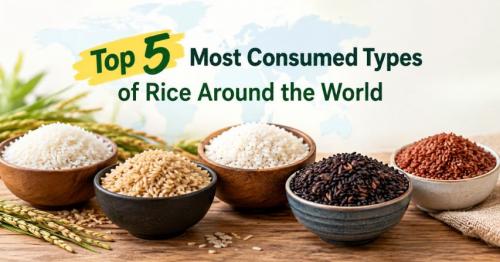
Top 5 Most Consumed Types of Rice Around the World
What About White Rice and Brown Rice?

White and brown rice are slightly different categories because they describe how the grain has been processed, rather than a specific botanical rice family.
Brown rice retains its bran layer, while white rice has the bran and germ removed during milling.
This means you can have brown Basmati, white Basmati, brown Jasmine or white Jasmine rice.
White rice is generally quicker to cook and has a softer texture, while brown rice typically provides more fibre because the bran remains intact.
Why Rice Matters So Much Globally
Rice remains a central food-security crop.
The USDA describes it as the primary staple food for more than half of the global population. Asia remains the biggest consuming region, but demand is also substantial across Sub-Saharan Africa, South America and the Middle East.
The Middle East is particularly dependent on international supplies. USDA estimates indicate that imports account for more than 70% of regional rice consumption, making countries such as India, Pakistan and Thailand important suppliers.
Which Rice Is Most Popular?
Looking at international trade, the broad picture is clear:
Ordinary Indica long-grain rice dominates, while aromatic rice — particularly Basmati and Jasmine — represents another major global category. Japonica is essential across East Asian cuisines, while glutinous rice has deep cultural importance in Southeast Asia.
Ultimately, people's favourite rice often comes down to where they live and what they eat.
Someone in India or the Gulf may immediately choose Basmati, while a Thai household may prefer Jasmine and a Japanese family may use Japonica every day.
Which rice do you eat most — Basmati, Jasmine, long-grain, Japonica or sticky rice?



Comments