
Sultan bin Ahmed Announces $1.6 Million Jawaher Al Qasimi Humanitarian Innovation Centre in Indonesia
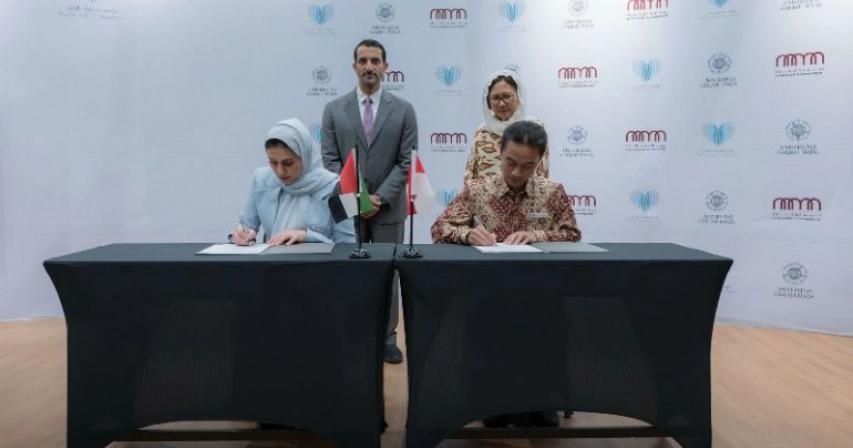
New centre at Universitas Gadjah Mada in Yogyakarta will connect academic research with humanitarian field expertise, focusing on food security, climate resilience, livelihoods, women’s empowerment and community development.
Sheikh Sultan bin Ahmed bin Sultan Al Qasimi, Deputy Ruler of Sharjah and Humanitarian Envoy of The Big Heart Foundation, has announced the establishment of the Jawaher Al Qasimi Humanitarian Innovation Centre at Universitas Gadjah Mada in Yogyakarta, Indonesia.
The new centre will operate as a permanent multidisciplinary platform designed to connect academic research, knowledge and innovation with practical humanitarian experience, helping develop solutions that can be tested, implemented and expanded within communities.
$1.6 Million Partnership
The centre is being established through a partnership involving The Big Heart Foundation, NAMA Women Advancement Establishment and Universitas Gadjah Mada, with total funding of $1.6 million.
The Big Heart Foundation will contribute $1 million, while NAMA will provide $500,000 and Universitas Gadjah Mada will contribute $100,000.
The agreement establishing the centre was signed by Mariam Al Hammadi, Member of the Advisory Board of The Big Heart Foundation and Director General of NAMA Women Advancement Establishment, and Dr Danang Hadmoko, Vice Rector of Universitas Gadjah Mada for Research, Business Development and Partnerships.
Turning Research Into Practical Solutions
Speaking during the signing ceremony, Sheikh Sultan bin Ahmed highlighted the role universities can play not only in education and research but also in applying knowledge to challenges faced by communities.
The centre is intended to bring together academic expertise, humanitarian organisations and communities so that research can be translated into practical projects and measurable outcomes.
Its work will cover interconnected humanitarian and development challenges including food security, climate change, livelihoods, economic opportunities, disaster-risk reduction, women’s empowerment and maternal and child wellbeing.
The initiative is also expected to develop solutions that can initially be tested in Indonesia before potentially being expanded across Southeast Asia and other regions.
Four Strategic Areas of Work
The Jawaher Al Qasimi Humanitarian Innovation Centre will operate through four integrated strategic tracks.
These include multidisciplinary research and policy studies, hosting researchers and specialists, launching humanitarian innovation challenges and project incubators, and developing solutions that can be tested directly within communities.
The centre will also support community dialogue, youth leadership programmes, awareness initiatives, social-development projects and economic empowerment programmes.
A dedicated investment endowment fund is also included in the agreement, with returns intended to provide sustainable financial support for the centre's programmes.
‘Living Humanitarian Lab’ Planned
One of the initiative's main components will be a Living Humanitarian Lab.
Universitas Gadjah Mada has allocated approximately two hectares of land for agricultural innovation, applied experiments and direct community engagement.
The lab will focus particularly on areas such as food security, sustainable agriculture and community empowerment.
Alongside the lab, the centre's main headquarters will host research activities, collaborative projects, community events and exhibitions showcasing humanitarian initiatives and products created by beneficiaries.
Supporting Women’s Education
The new centre also builds on an existing partnership between NAMA Women Advancement Establishment and Universitas Gadjah Mada through the Jawaher Fund for the Advancement of Women’s Education.
The programme provides support for women seeking postgraduate education.
According to the official announcement, its first group included three female students selected from 136 applicants, with the initiative covering financial commitments and tuition fees for students accepted into postgraduate programmes.
The expanded cooperation will also include projects involving women farmers, rice production, waste management, community nutrition and inclusive social innovation.
University Brings Large Community Network
Universitas Gadjah Mada Rector Dr Ova Emilia said the partnership builds on the university's focus on education, scientific research, innovation and community service.
The university already operates programmes that enable students and academics to work directly with communities across Indonesia on areas including health, education, environmental sustainability, livelihoods, disaster resilience and social development.
Its system of community and field engagement has exceeded 10,000 activities or deployments, according to the announcement.
The university plans to use this network to help test research findings and humanitarian innovations in real community settings and potentially expand successful programmes to additional locations.
Sharjah Expands Humanitarian Partnerships
The establishment of the centre forms part of Sharjah-linked humanitarian organisations' wider cooperation with institutions in Indonesia and Southeast Asia.
Sheikh Sultan bin Ahmed said the project reflects an approach centred on investment in education, knowledge and community development while connecting academic institutions more closely with humanitarian work.
The university will begin preparing the centre's headquarters in the coming period.
Organisers aim for the Jawaher Al Qasimi Humanitarian Innovation Centre to eventually develop into a regional platform for humanitarian knowledge and innovation, supporting projects that can produce sustainable and scalable benefits for communities in Indonesia, Southeast Asia and beyond.
By: simran



Comments